
Parkland Previous-Resident Sources by Era
The best source depends on the date and the question. A deed names parties to an interest in land, while a directory or census can supply household evidence. Permit and map records date changes to the site. Parkland address history is strongest when these records agree.
| Source | Years or era | Where held | What it can show |
|---|---|---|---|
| Recorded real-estate index | Modern and historical routes vary | Pierce County Auditor | Grantor, grantee, instrument, date, legal description |
| Tacoma-area directories | Leads from 1885; address cross-reference useful after 1928 | Tacoma Public Library and Archives | Names, occupations, spouse notes, address listings |
| Polk directory runs | Selected years through the twentieth century | Puget Sound Regional Archives and TPL | Dated household and business listings |
| Federal census | Public schedules through 1950 | National Archives and library access | Household members and census location |
| Permits and property cards | Coverage must be checked by parcel | Pierce County and regional archives | Site changes, applicants, valuation or building facts |
| Sanborn maps | Tacoma-area leads for 1885/1888, 1896, 1912 | Tacoma Public Library catalog | Building footprint and historic street context |
Begin with the newest firm fact. For a modern house, that is usually the parcel and current deed. For an older family question, a directory or census may identify a household, but the printed place label and address must be preserved exactly.
Anchor Parkland Resident History
Enter the address in Pierce County ATIP and collect the ten-digit parcel number, physical site address, taxpayer delivery address, and legal description. The site address locates the land. The delivery address is where tax mail goes and can be different. That distinction prevents a mailing contact from being mistaken for a previous resident.
Next, use PublicGIS to confirm the parcel's map position and planning context. Parkland is an unincorporated community, so a Tacoma mailing label does not move the parcel out of Parkland's community geography. Conversely, a Parkland postal label does not by itself prove that a record falls within a particular census or planning boundary.
Keep the legal description through the whole search. Street names and numbers can change, while a plat, lot, or section-township-range description offers a more stable bridge between present and historic records.
Walk Parkland Deed Records Backward
The Pierce County Auditor maintains the official recorded-document routes. A deed trail begins with today's indexed owner and works backward from buyer to seller. The county cautions that parcel-linked documents are not a complete title search, so use the party index and legal description as well as any parcel link.
- Copy the current owner and legal description from ATIP, along with the date of access.
- Find that owner's acquisition instrument in the Auditor real-estate search. Record the instrument number, date, grantor, grantee, and legal description.
- Search the seller as a grantee to locate the earlier purchase. Confirm that the land description matches.
- Repeat one transfer at a time. Review easements, covenants, releases, plats, mortgages, and boundary adjustments separately from deeds.
- When the current search stops, move to the historical index, then ask the Auditor or archives about older books and copies.
- Grantor
- The party giving or transferring an interest.
- Grantee
- The party receiving that interest.
- Chain of title
- The sequence of recorded transfers tied to the same land.
- Legal description
- The recorded land description, often more durable than a street address.
- Instrument number
- The unique identifier assigned when a document is recorded.
Online images may be redacted and are not certified copies. Use the Auditor's posted mail, counter, or certified-copy route when the image itself must serve as official evidence.
Parkland Previous-Resident Recorder Routes
The live real-estate search and historical index are distinct Pierce County routes. Do not assume that a failed result in one means no instrument exists. Try party-role changes, date ranges, spelling variants, and the legal description. Common names require special care.
The Pierce historical index search is a key handoff when a Parkland previous-resident trail leaves the modern interface.
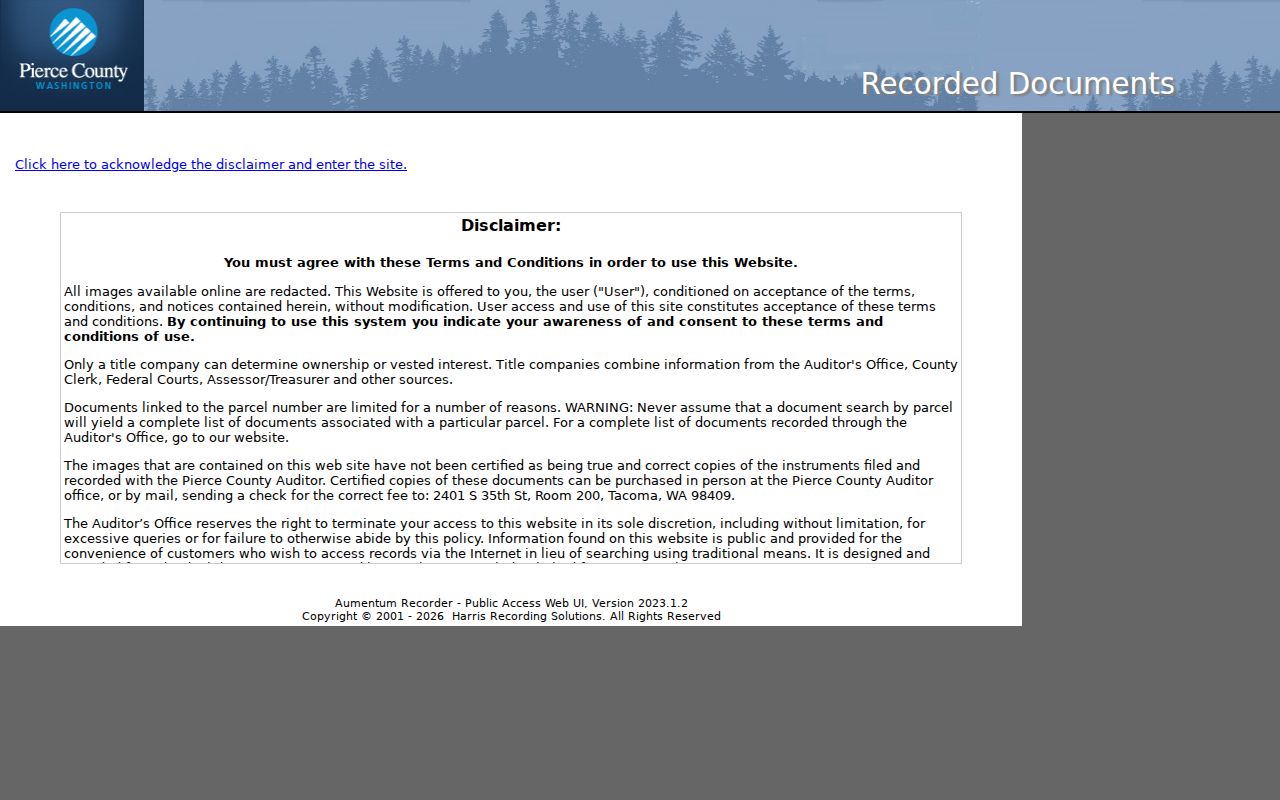
The captured search surface supports a book-and-index stage, not a promise that every image is online. Save the exact citation and ask for staff help when the referenced page cannot be opened remotely.
Note: A county index points to recorded documents, but it does not establish every person who occupied the Parkland property.
Match Parkland Resident Records
Ownership is only one layer of previous residents. Tacoma Public Library reports directory leads beginning in 1885, spouse listings from 1911, and especially useful address cross-references after 1928. Puget Sound Regional Archives lists selected Polk runs, including 1951, 1955 through 1963, 1965 through 1966, 1968 through 1970, 1972, 1974, and 1976. Availability is not the same as complete Parkland coverage.
Use a short process flow: old address as printed → directory household → nearest public census → deed or property card → newspaper, obituary, or probate check. Compare the name, spouse or household notes, occupation, and exact place label. A name absent from one annual directory may reflect timing, publication practice, or rural-route coverage rather than a move.
The detailed collection history belongs on the Parkland city directory page. For a prior household search, extract only the entries tied to the subject address and log each directory year separately.
Find Parkland Residents in Archives
The Tacoma Public Library Northwest Room holds Tacoma and Pierce County local-history and genealogy material, including directories, newspapers, maps, photographs, and building-research sources. Its staff route matters because not every volume or address cross-reference is digitized. A concise request should include the address exactly as known, alternate postal labels, a narrow date range, and the parcel or legal description if available.
The Northwest Room ORCA catalog helps discover collection descriptions and digitized items. The Puget Sound Regional Archives adds directory, census, school, probate, property-card, and other county record groups. Pierce County Historical Association maintains newspaper, family-history, and plat-map leads. Search all three catalogs before concluding that a gap in one institution is a gap everywhere.
Map Previous Parkland Residents
Parkland and Brookdale plats date to 1890, after an 1888 railroad connection helped shape local growth. An older directory may use Parkland, Tacoma, Brookdale, Spanaway, Fern Hill, or a rural route. Preserve that historic label. Then compare a recorded plat, county parcel geometry, and a period map before proposing a modern address match.
Tacoma Public Library's catalog provides Sanborn fire-insurance map leads for Tacoma-area volumes dated 1885 or 1888, 1896, and 1912. These maps can show a building footprint, construction details, and street setting when the property lies within mapped coverage. They do not list everyone living inside.
The Sanborn catalog search shows the available map leads for the next stage.
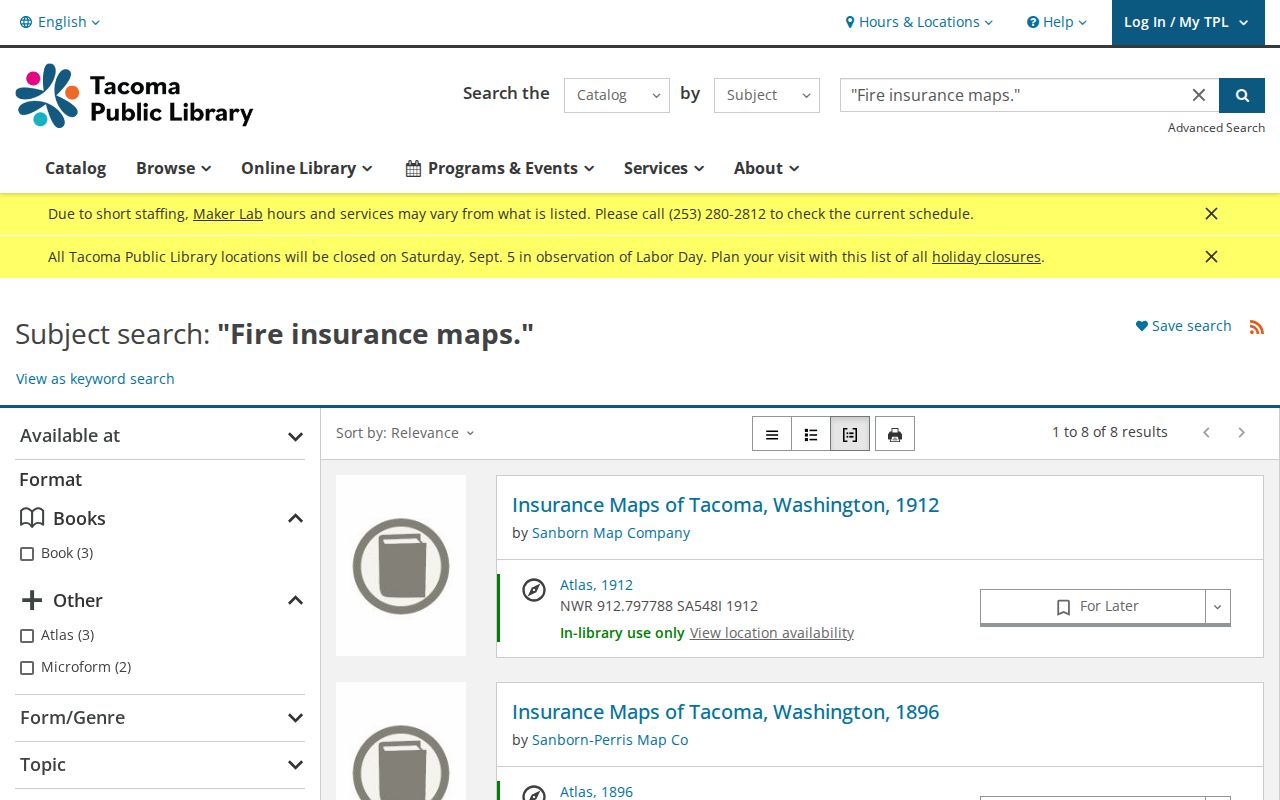
The image links building history to a specific catalog rather than an unofficial map list. Check the volume, sheet, and coverage note before adding any map fact to an address timeline.
Date Parkland Resident Records
Pierce County PALS can connect a parcel or site address to permits, application status, documents, and inspections. Regional archive property cards and library building files may extend that timeline. Together, they can explain when a structure changed or why an address appears differently. They do not prove that the applicant, contractor, or tax contact resided at the site.
Build a four-column research log: date, source citation, address or parcel, and supported fact. Add a confidence note whenever the old and modern address link is inferred. This method makes conflicts visible and prevents one convenient name from swallowing contrary evidence.
When a portal lacks the needed scan, ask for the record through the documented channel. Pierce County's public-record process covers county agency files under chapter 42.56 RCW and generally calls for an initial response within five business days. That response can supply the record, give an estimate, seek clarification, or cite an exemption. Court files use the Clerk's separate request path. Library and archive staff have their own reference procedures.
A focused request is easier to fulfill. State the Parkland address, ten-digit parcel, approximate year, agency, and record type. Ask for a property card, permit file, index page, or named series rather than asking staff to determine every prior occupant. The latter would require research and may seek a roll that the agency never created.
Parkland Records and Owner Alert
Pierce County Owner Alert can watch up to ten name, parcel, subdivision, or condominium variants for future Auditor recordings. It is free and can help a current owner spot a matching instrument. Common names can produce false alerts.
The service does not prevent a fraudulent recording, reverse a transfer, cover another county, or replace a title search. It also does not identify previous residents. Use it after a history project only as a current monitoring tool, then inspect any alert against the actual instrument.
Limits on Parkland Previous Residents
A complete occupant list rarely exists. Deeds show recorded interests, directories show published listings, census schedules show households on an enumeration date, and obituaries or probate files document particular life events. A person may own without living there, live there without owning, or be missing from a directory. State and federal release rules can also keep recent records closed.
Lawful use. Research Parkland previous residents for family history, estate work, house history, or personal curiosity. Never use records to track, stalk, harass, or expose a living person.
Washington's Address Confidentiality Program protects eligible participants through substitute addresses and mail forwarding. Do not combine old and current sources to defeat that protection. Phrase conclusions as dated facts: “listed at the address in the 1955 directory” is sound; “lived there continuously” requires far more evidence.
Close the research log with unresolved gaps. Note years for which no directory was located, deeds whose images require an office request, and address conversions that remain uncertain. A gap is not evidence that a household left Parkland. It may reflect a missing volume, rural delivery, a spelling change, or limits in the online index.
For a deceased person, an obituary, cemetery record, or probate file may connect relatives and dates to the address trail. Parkland Lutheran's history offers a cemetery and burial-list lead through 1999, while the regional archives hold probate and family-history sources. Treat each as its own record. Verify the identity with dates and family links before merging it into the prior-resident timeline.